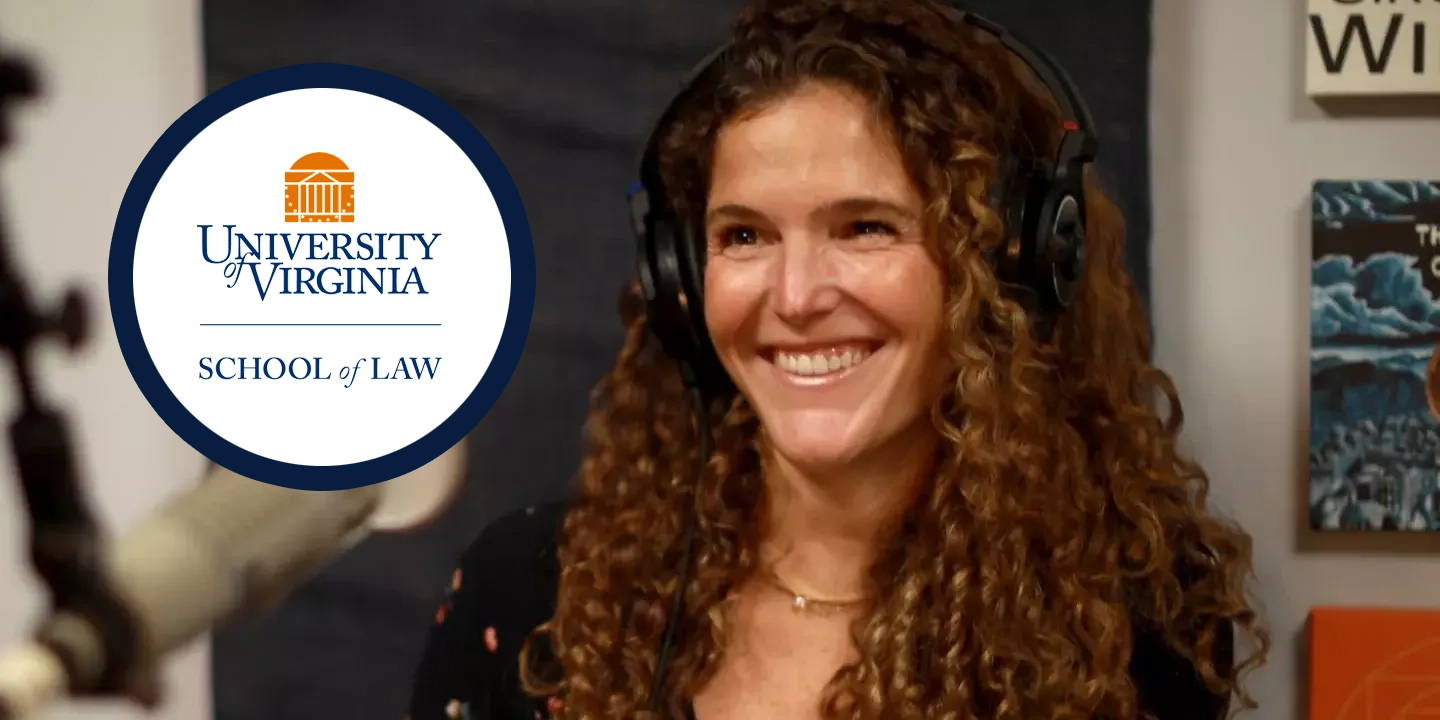
Anna Hicks-Jaco: Hello and welcome to Status Check with Spivey, where we talk about life law, school law, school admissions, a little bit of everything. I'm Anna Hicks-Jaco, president of Spivey Consulting, and I am absolutely thrilled to be here today with Dean Natalie Blazer, who is the Assistant Dean for Admissions and Chief Admissions Officer at the University of Virginia School of Law, where she's led the admissions office for the last five cycles. Prior to that, she was the Director of Admissions at Georgetown Law, and the Associate Director of Admissions at Columbia Law. She's also a graduate of UVA Law and was a practicing attorney for a number of years before getting into admissions. She's also the host of the fantastic law school admissions podcast Admissible, which we'll have linked in the show notes.
We covered a lot in this episode: predictions and advice for the upcoming 2025-2026 admissions cycle, whether medians will go up this fall, how UVA is addressing the new student loan cap in the "big, beautiful bill," the huge LSAT inflation that we've been seeing and its possible causes, super high GPAs and when they start to become sort of meaningless, whether admissions offices can or have to be more focused on "softs" with the influx of high-stat applicants, how admissions offices are considering applicants writing about politics and protest in applications in the current political climate, how they're thinking about work experience when the job market for new college grads perhaps conflicts with other economic indicators, changes they've made to their application this year, whether writing about AI is overdone, advice for their Why UVA essay and how applicants got it wrong last year, and more. So, without further delay, here's our interview with Natalie!
I am so pleased to be here with you today. I've had the pleasure of knowing you for a number of years, I believe about five years at this point, and I have always thought so highly of you, and of course of UVA Law, which I attended and absolutely loved. So thank you so much for joining us. I have a ton of questions for you, so let's jump right in.
(1:56) It is currently August of the 2025-2026 admission cycle. It's about to get started. So, what predictions do you have for how the cycle is going to go? This is something that Reddit is certainly wondering about. From the LSAT registration numbers, it does look like it's going to be an up cycle from this very, very preliminary data. We don't have anything concrete as far as applicant numbers, but as of today, August LSAT registrants are up about 27% from last year's August test. That will come down as people will not show up on test day. We are recording this on August 6th, but it's going to end up still up. And this past cycle was already up 18% from the cycle before that, so this is pretty unusual.
So what are your predictions? How far up will this cycle be if it is up? What do you think the pace of the cycle will look like? And are there any other trends or differences that you think applicants should be anticipating, aware of?
Natalie Blazer: Well, first of all, thank you so much for having me! I always love being on this Spivey podcast.
Predictions, gosh. It's hard. Last cycle was a very, very busy cycle. Ton of applications, super strong applications. LSATs were up. As we know, grades continue to go up. It's getting actually tougher and tougher to choose a class. I mean, you would think the more strong applicants, the easier it gets. I actually think it's sort of the opposite, because it's kind of at the margins where you're selecting people, and that's why I think resources such as this, and what I try to do on my podcast—it's like, it's going to be those little things that sometimes can make the difference, because there are so many qualified people out there these days. It's going to be those things, again, on the margins that set you apart.
So I think this is going to be another cycle like that. The times we're living in, I think, are motivating people to go to law school. Could also talk about job numbers, the economy. It's sort of complex, because I think, technically, the economy is decent right now, and so usually that means people aren't going to go to law school, but actually, I think the job market is not that great for people coming out of college. So, all that is to say, I think it's going to be another very busy cycle. I think it's going to be another cycle of very strong applicants, and that's exciting. That energizes me to see people coming in who want to make a difference, who want to make a change in the world, who want to go help people, fight for people, so I'm excited.
(4:18) Anna: Yeah, yeah, definitely. I have a follow-up question on that, as you're talking about people's motivations for going to law school. I was reading some advice online the other day that was, sort of, cautioning people against writing about a passion for politics or a politically-oriented cause in your law school application, given the current political climate, not only with the Trump administration's scrutiny on higher education, but with all of the public discourse around campus protests.
There was also the advice that these types of essays, especially about the Trump administration, could be overdone. What's your take here? What's been your experience reading these types of essays? And I'm sure you've read many over the last cycle in particular.
Natalie: Yeah. That's a great question. And on the one hand, I would say the most important thing in an application is to be authentic, right? So if there is something that is really motivating you to go to law school, I would have a tough time advising somebody against writing about that. At the same time, sort of, being mindful and thinking, "What is relevant to my candidacy for law school? What are my goals?" You always have to think about who is reading your application. You never know who's reading your application, and we all are meant to be, obviously, objective and not inserting our own politics or views, worldviews, but you should be conscious of how you might come across. So, I think based on people's resumes, based on things that they choose to tell us in the application, do we have a sense of the way someone's leaning? Yes, of course. And politics and law are sort of intertwined in a way that is natural and makes sense. So I would maybe caution people against being extreme in any way in their application, while also staying true to what causes do matter to you. I think it's challenging, because when I went to law school, politics was not so enmeshed and in the discourse. Now, it's really hard, I think, for folks applying to law school now to extricate politics from their passions. So I think it's a balance.
Anna: I think that's great advice. I think your point about authenticity and your true, authentic motivations for going to law school is so important. And then your caution about being dogmatic about it, I think is where you want to be really careful and, sort of, signaling that you are closed off to other ideas, other perspectives, I think you want to really avoid that. And I think, where you can signal that you are open to other perspectives, that you are interested in having discourse with people who disagree with you, I think that's really important today, especially, with the climate of things.
Natalie: Yeah, and one thing at UVA that we really pride ourselves on is having ideological diversity. We ask specifically on our application about your ability to engage across differences. So exactly what you just said. If you can demonstrate that you are passionate about something, but you have changed your mind about something, or you have reached across the metaphorical aisle, I love when I see passionate people, but I especially love when I see that they are open-minded, that they are, like you said, not dogmatic, and that they can be productive in their discussions and respectful in their discussions, because that's a lot what law school's about, really.
Anna: Yeah, that's so important. I think there's nuance here for sure. And thank you for illuminating that nuance.
(7:36) I have another follow-up question on what you were talking about before, when you were talking about the economy and that sort of tension between the economic indicators that we would typically look at and say, okay, the economy is looking good in ways that would typically lead to not a huge surge in law school applicants, but then the job market for new college grads, it conflicts with that. There's tension there.
So my question is about work experience and how you look at work experience. By all or at least most accounts, work experience is more important than ever in law school admissions, and I think that's for good reasons. Work experience is important in gaining employment. Everybody cares about employment, administration, students, applicants, for good reasons. But with this new college hiring market, it is increasingly difficult, I think, for a lot of new college grads to get full-time work in the field that they're looking for, full-time work that they are qualified for. I hear from recent grads all the time that they're having a really tough time out there. Do you take that into account as you evaluate, you know, "KJDs," people who are coming straight from college, or recent grads who haven't been able to get that full-time work, or full-time work in the field that matches their qualifications? Or do the practical realities and benefits of that experience have to outweigh that context and possible, sort of, mitigating factors?
Natalie: That's such a great question. I'm a KJD myself, so.
Anna: Same.
Natalie: Yeah, okay. So you get. I mean, I feel that, even though the trend is much more in having people have work experience, I feel that I am a great example of somebody who, I had summer jobs, I worked through college, you know, I had all kinds of jobs and internships and specifically legal jobs and internships while I was in college that really made me know that law school was the right choice. I think that's really what is the key if you are a KJD. You know, you do have to make use of your summers. By the way, I don't just mean some Capitol Hill internship, I mean just working, working in the real world in some fashion. I was a server at Bennigan's, which your listeners may not even know, but it's basically like a TGI Fridays. I worked at the Gap, in addition to internships, and I worked as a paralegal and things like that. It does not need to be necessarily legal-related, but I do feel that the more work experience you have as a KJD, in those summers or during your school year, can help you know that this is what you want to do, and can help you in the job search process. Because as you know, that's just getting earlier and earlier and earlier. Whatever your resume is entering law school is what employers are essentially looking at. So it's your maturity level, it's your professionalism, it's all the skills that legal employers are going to be looking for. A KJD can absolutely have those things.
For folks who have been maybe impacted by the economy or, you know, they don't have the work experience that they want, it kind of reminds me of COVID, where a lot of people, things got canceled. Or, you know, they couldn't study abroad, or they had this really great internship lined up, and it got canceled. And it's unfortunate, but we know. We know that the context and the world events that are going on that is that that person doesn't have the experience that they may have wanted.
I think there are definitely ways around that. When you think about why work experience is important, it's important because it gives you a perspective. I think it puts things into perspective when you're in law school. You maybe have a bit of a work ethic that's important. Again, the maturity piece, the professionalism piece. You can have that with all kinds of levels of work experience, all kinds of jobs. It really just comes down to the individual. I wouldn't ever say that everyone needs to work two years at Deloitte, or, you know, an internship on, like I said, on the Hill, or XYZ. It really doesn't matter what you have done or for how long you've done it. It's really what you made of that time, what you took out of that.
And the reason that we interview everybody for admission is we are trying to get a gauge of, are you at the level where you can go in front of a legal employer pretty much day one, and how carefully have you considered the decision to go to law school?
My advice for people out there who are worried, they haven't gotten the job that they want to get, make the most of what you can do. Find a volunteer opportunity. Get involved in your community. Spending time productively is really what we want to see. And we want to see, what is your narrative like? Things not going your way is going to be a lot of your law practice. You're going to have to be adaptable. So I really appreciate when people don't take the, like, woe-is-me approach, but they take the, like, I made the most out of the situation, and this is what I learned from it. This is how I grew from it. That's what I really like to see. That's who I think is going to make a strong law student and lawyer.
(12:30) Anna: That's great advice. Thank you.
Okay, backing up for a moment. As I was saying, we are on the cusp of this new cycle, and your application, UVA's application, is not open yet. The vast majority of applications are not open yet. Can you tell us, have you made any changes to your application this fall?
Natalie: Yeah. Gosh, you know, next Friday—I am currently working on my speech to welcome 300-some 1Ls, and then two weeks later, our application opens. It's just crazy.
Anna: Busy time!
Natalie: This cycle, you know, it's really wild. But yes, our application is going to look very familiar to folks if they're reapplicants. We really haven't changed much. One thing that I'm very happy we've changed is our Why UVA prompt. Last cycle, what we were trying to do in our wording of the prompt is reassure people that they did not need any connection to UVA whatsoever in order to be interested in UVA. Our wording was a bit unfortunate, and I think it led some people to believe, in fact, the opposite.
We have gone back to the bare bones, if you have a specific reason for wanting to attend UVA Law, you are welcome to share it here. This question is optional, as it has always been, and probably always will remain optional. And please know that when we say optional, we mean optional.
Here is why we tried to change the language last year. We said something like, "If you have an experience with UVA that makes you especially excited to apply," or something like that. We were trying to get away from people just reading the website, dumping a bunch of facts. That is never helpful.
Anna: Like in their template "why" essay.
Natalie: Yes. We were trying to get people to insert more of their personal narrative into it. So if you are really excited about our Law and Tech Center, but you have never stepped foot in Charlottesville, you have never, you know, had any connection with UVA, you don't know any single person who went here, why are you personally interested in the Law and Tech Center? That's what I want to know. You can talk about how great it is, and you could talk about how Professor Citron is amazing, and all these things, but you have to tie it back to yourself, just like in your personal statement. It always has to come back to, why does it make sense for you?
So that's really just what I would urge people to think about. The prompt is back to its simple self, but I do want people to, if they don't have specific reasons, don't write one. If you do have a specific reason, I definitely would love to hear about it. I just don't want to read a set of things that I already know about without understanding better how it connects to you personally.
Anna: Totally. That makes complete sense. That's something that we talk about on our team all the time with these "why" essays is that, if you are just listing programs that the school has, admissions officers already know what programs the school has. They know that they're great programs; they know that they have amazing professors. You have to connect it to yourself, you have to connect it to the things that you have done, the perspectives that you have, and why they're important to you.
Natalie: Right, and when you just list things like that, it doesn't come off as that genuine. So again, all coming back to authenticity and being yourself and being genuine. And you don't have to have, even, super intellectual reasons for wanting to go to UVA. Maybe you've just heard the community is great and you thrive in those environments. And by the way, if I have seen in the rest of your application, "Oh, this person is very community-oriented, they were really involved in college," then that will make sense to me. As a narrative, it will all be cohesive. Like, "Maybe they're still open-minded about what they want to study in law school and what kind of law they want to do, but personality-wise, I get why they are drawn to us." So, again, it should all be true to yourself, but feel free to think broadly. If you really are interested in UVA, why? And then write about that.
Anna: Yeah. Are there any reasons that you see a lot in a Why UVA that you don't like to see?
Natalie: No, honestly! I do feel that people write about the community; they are drawn to that. They're drawn to maybe a smaller setting due to the nature, all the things that I love about it, frankly, people write about that a lot. And look, we do have a great quality of life here. But don't be mistaken, this is extremely rigorous. The academics are challenging, like any law school is going to be. And so we have these world-class professors, we have all the things of this top-notch legal education, so when people mention those specifics, I like to see that, too. So again, whatever is most true to you, I would say right about that.
Anna: Yeah, absolutely. I think authenticity is a huge theme for pretty much all things law school admissions.
(17:04) Okay, going back to our predictions for things that are going to happen in the next month, but I know everybody on my team is super curious and applicants are super curious. As you know, the law school admissions community is fairly small with the number of law schools that there are—are you hearing from your peers at other schools that they're going to be changing their applications? Do you think applications are going to be significantly different this year, or are they going to look a lot like they were last year? Have you heard other perspectives on this?
Natalie: Well, I heard Dean Z on your podcast talking about her new AI question, which I'm very fascinated.
Anna: That's an interesting one.
Natalie: Yes. AI, I think, is on everybody's minds for a lot of different reasons. Other than that, sort of, the climate that we're in, I think I wouldn't be surprised if some other schools are changing things on their applications. I have not heard personally, other than what Dean Z mentioned with the additional question, so I'll be very interested to see, but I don't have firsthand information. Ours, as I mentioned, is going to be largely very similar to what it was last year.
And by the way, like, just in general, I don't think it's great to, like, hugely change your application year to year, because it just makes it harder to put applicants into context. I mean, you have to, like, adapt and do things that make sense for the times, of course. But if you're changing it wildly year to year, it's hard for people to get into a rhythm of what a good application is, so.
Anna: That's a good point. Well, we'll see. We'll find out what big changes or small changes there are. This is something we're always closely tracking, so we'll find out. I imagine you're probably less closely tracking, less important for you.
(18:37) Okay, I have another question from Reddit. And this is actually something that I believe we talked about the last time you were on our podcast, or maybe the time before that, but most people probably haven't listened to that; it's from several years ago. But with the huge increases that we're seeing in highly qualified applicants, as you were talking about, do you feel that you are able to care about the sort of soft factors more? And do you think that other schools are able to care about the soft factors more? And I'll add here for our listeners, as you know, Natalie, as another possible factor, US News' substantial decrease in the weight of the LSAT and GPA metrics in the rankings, which, of course, even if a given admissions officer doesn't care about the rankings, some applicants do, students do, alumni do. The administration kind of has to as a result of all of this.
Those are the factors. Are we able to care about softs more? Do we care about softs more, broadly, in admissions than we perhaps did five years ago?
Natalie: Great question. So, I mean, what I tell people in my podcast and when they come for Q&As—we do a Q&A in person here every Friday throughout the school year—and I tell people, there are going to be so many people with your exact stats or better. That, as I said earlier, makes it much harder for us, you know, okay, so you have a 172, 3.98, and then you have another one right there. So how do you differentiate those people, if not for—I mean, of course, you have whatever their major was and what school they went to. But really, if you have those people with the same numbers, they're going to impact your medians the exact same way, what do you have but the softs? Their resume, their work experience, their personality, for lack of a better word.
Unfortunately, I wouldn't say that admissions metrics matter less, but the other things matter more, because so many people have the metrics. Because the LSAT keeps going up and the GPA keeps going up, we don't want our medians to keep going up, but we have to keep pace with the pool.
If LSAC is listening, I have a wishlist for LSAC that is a mile long, but I wish that when they would address the scores, what is going to happen when we reach 180? It's almost like, do we realize how close we are to getting to that? I mean, the schools at the upper tiers, you know, we're in the low to mid-170s, and people's medians are going up pretty much every year.
Anna: There's a ceiling here. We're close.
Natalie: There's a ceiling. And same thing with GPA. I mean, are we going to all have to admit 4.3-whatever? It really just kind of feels like nobody is addressing it. Maybe there's a plan in the works that I don't know about, but I just want applicants to know: we don't think a 165 is not a good score. We don't think that. And in fact, we admit tons of people every single year with a 165 and below. We just sort of have to work with the pool that we're given and work with the scores that are being achieved and the GPAs that are out there.
Anna: Yeah. I saw my first straight 4.33 GPA the other day. Someone who applied to our Pro Bono Program had a 4.33. I was shocked. Amazed!
Natalie: Well, I mean, if you look at the median GPAs out there of law schools, we're going to cross a 4.0.
Anna: I know. I'm going to be shocked whenever someone reaches a 4.0 for their median. Mind-blowing.
(21:50) Okay, I've two follow-up questions on that, on the numbers. First is, speaking about this LSAT increase, this inflation, what are your theories on the causes of this?
Natalie: When I took the LSAT in September 2004, they would average your scores. I knew, based on practice tests, what I was going to get most likely, and when I got my score back, I was happy with it, and that part of my life was over. I went into the test saying, "This is game day. This is my one shot to get the score I want." It did not even occur to me to take it again. I was living in Boston. I was at Boston College, had to get on the T, which is like the subway, to go all the way down to BU. That's the only place it was offered. It was in person. It was four times a year. It was a huge production. If I took it again, I just ruined my first score. So it was more difficult to take. There were barriers to taking it. I had studied all summer long while working a full-time job, and I had my whole senior year to, like, work on my thesis and get my grades where I wanted them to be, all these things. I just think the barriers to taking it are way lower.
Anna: Definitely.
Natalie: You can take it remote, you can take it in person. You can take it, like, umpteen times a year, and they now take the highest score. And so now, when people can take it more and more times and it's not going to impact their score and they can just get the highest score, you're going to see higher scores. That's what I think.
They've also changed the test a lot since I took it. So, do I think it's an easier test? I don't know. LSAC says it's because people are studying more and—
Anna: It's the exact same test, perfectly the same and valid and reliable.
Natalie: Of course, as always. Even though all of the sections have changed, and it's shorter, and.
So what I try to tell people, I don't want to sound like in my day XYZ, but in law school, you are going to take your criminal law exam one time. You need to get used to performing on what I call game day. You do not get a redo in law school. You do not, at least not at this law school. Why not get into that mindset? Of course, now, given that we're in 2025, they will take the highest score. Of course, you can always retake it. But going into the administration thinking you're going to retake it—why would you perform your best that day then, if you've already kind of thought, "I can do this again"? That's just the way I see it.
So I think scores have gone up because people just take it more times, and because it's a different test, the remote scenario, you can be more comfortable, you don't have all these external factors going on in a room, or, like, things like that.
And I want to make clear, if something really goes wrong on test day, of course, take it again. If you didn't feel your best, if you were really scoring 10 points lower than you were on your practice exams, of course, take it again. But performing under pressure is a really big part of law school; it's a really big part of practicing law. I want people to, sort of, at least try to get into that mindset. It's great practice for law school.
Anna: Yeah, yeah. I think that's good advice. I think there are arguments to be made that a lot of the changes that have happened are very positive in terms of increasing accessibility to the LSAT. And I think a lot of the problem is just that it's being messaged as this exact same test, perfectly valid and reliable and the same scores as they were 5 years ago, 10 years ago, whatever.
Natalie: I will say, I do think there is something to LSAC's point that people are more prepared.
Anna: I think people are studying more.
Natalie: People are studying more. There are way more resources. Way more. I'm sure you could go on TikTok. I'm sure you could go on Instagram. I'm sure you could find stuff. I don't want to make it sound like I don't think people are really working hard for these. They are.
Anna: Definitely.
(25:32) Okay, I have a question about GPAs, and this is not necessarily about, sort of, medians or the broad scale. But when you're looking at an individual application or a few applications, is there a point at which the difference between one incredibly high GPA and a slightly higher incredibly high GPA becomes functionally meaningless to you, assuming two basically similar degrees qualitatively?
Natalie: Yes, for sure. If your GPA is at the median, anything above that, it doesn't matter. And same thing with below—I mean, to a lesser extent. Because, like I said, GPA medians are out of control at top law schools because of grade inflation and what we're seeing in the pool. As I said, we're just kind of following the pool and following what undergrads are doing.
If you're at—let's say a school's median is a 3.9. If you're at a 3.9—or a 3.92—you're meeting their GPA median, so it doesn't actually matter. Unfortunately, if you're a 3.89 or a 3.9, that's where it matters. So if you are at a school's median, I wouldn't be worried about, "Oh, I'm only at the median," but keeping in mind that schools are going up every year, so in that sense, yeah, sure, having a little cushion makes a difference.
And then on this flip side, if you're below GPA median, again, half the people are below. It's really, like, what are your grades and what were your courses and what was going on, if your GPA is lower? The GPA, no matter what it is, no matter if it's above, below, at, we are looking at the full context. What courses you took, were you working full time, were you a student athlete, were you writing a thesis? In full context. It's not just a number.
So I want to be a realist and, like, make sure people know that, like, yeah, sometimes a 10th of a point is going to matter. But really in the big picture, we care much more about your education, your work ethic. Are you going to be able to do the type of work that's required in law school?
Anna: Yeah. Once you get beyond the medians, you're really looking at this, assessing, is this person going to come to UVA and be a successful student?
Natalie: Yeah. And all the other things, the package. Yeah.
Anna: For sure.
(27:47) Okay, I promise this is my last question that is just about numbers. But as applicants try to plan sort of grounded, realistic school lists, and start sending in their applications, often, sort of, all before 509s come out and they have all of the official numbers that schools release—can I ask you, in a broad sense, certainly not naming any names, do you predict that law schools' medians will mostly be going up this year? Maybe, in particular, UVA's peer schools?
Natalie: I would say yes, just because of the pool that we saw last year.
Anna: Yeah.
Natalie: Again, this is not because we want to be going up necessarily. It's more that the pool was extremely strong. The LSAT scores, as you know, in the 165 to 180 range were up crazy amounts, and even in the 175 to 180, those scores were up. And so I would be very surprised if our peers didn't go up on at least the LSAT, if not the GPA.
But then, you know, it's funny, because there are some schools that I'm always kind of like, "good for you," because they don't move much. I will say I sort of almost envy them. In some ways, though, that makes their job even more difficult, because they have a much broader pool that they "can" pull from and still meet their medians.
But look, the whole median aspect of law school, I have a love-hate relationship with it, because on the one hand, it's very helpful to help us understand somebody's capabilities, someone's intellect, work ethic, drive, all these things, capability to succeed in law school. So it does help narrow the pool in some ways, but of course, I hate it because it is limiting. And it goes back to U.S. News, it goes back to all these things.
We need to know some sort of metric, because there are so many wonderful people out there, so many wonderful people. We need to know, who are the 300 who are going to really thrive at UVA Law and not only keep up in class, but really succeed and really go out into the world and make us proud as UVA Law alumni? I think metrics are really important for that, but really they're sort of a blessing and a curse in that way.
Anna: Yeah, certainly. I mean, you are looking at a very difficult job of differentiating between a huge number of applicants who, a lot of them are really qualified.
Natalie: We had almost 7,000 applications this past cycle.
Anna: Wow.
Natalie: So, how do you even begin, if you don't have something telling you this person's going to do well? You know, everybody who wants get rid of tests, I am so not on that. You can always look at a test within context, and you can look at it and know it's not the end-all be-all, but I'm like, "We need something as a starting point. Not as a decision-maker, but as a starting point."
Anna: Yeah.
(30:26) Okay, I have another question from Reddit, and this is an important one. How is UVA Law, in particular in respect to financial aid planning and practices, responding to the new provisions of the budget reconciliation bill, eliminating grad-plus loans and capping federal loans for professional students at $50,000 per year—which is, of course, below annual tuition for many law schools, including UVA?
Natalie: Yes. Well, I will tell you, from the day that this came out a month or two ago, the big beautiful bill or whatever it's called, I was talking with my financial aid dean. He is, like, wonderful. He is all over it. He was already fielding, of course, questions. Their phones were ringing, their emails were buzzing. There's a lot of resources out there for schools. You know, AccessLex is a great one, and just a lot of ways that financial aid offices can be really informed.
And so I think we have always had a very personalized financial aid counseling framework for admitted students, for current students, for alumni. It is very, like, one-on-one financial aid planning. And that is going to just be, I think, more important than ever, because people are going to have a lot of questions, and they're going to be worried. Our financial aid team is all over it. We are actually having a meeting with them in two weeks so that we, because we are, of course, going to get all these questions about it as well. We want to better understand what the game plan is. I think as far as other plans that might be in the works for, like, how are we going to help with some sort of loan structure or changing our public service loan forgiveness program, something like that, that's all quite above me, but those discussions are definitely happening.
I think what's important for applicants to know is, we completely get it. We know this is impacting everybody that is applying this cycle and beyond. And so, assuming that they take a loan out after the date next year, we're very mindful, and I think we're going to be really ramping up all of the counseling that is needed to meet the moment.
I will also say, a lot of things happening in this administration are, like, happening and then not happening, and then happening and then not happening. And so, I don't mean to imply that this is going to suddenly not be a thing, but a lot of things have just been sort of uncertain, and so, we are ready to help incoming students and applicants understand how to come up with a plan for this. It's going to be challenging, but I think we have a really good system in place, structure in place, to help applicants figure it out.
Anna: Okay. So it sounds like there's still, sort of, conversations being had about the specific mechanisms by which you're going to offer individual applicants, and this is going to be very individual and sort of one-on-one, in terms of how they're going to be able to financially plan for how to attend UVA Law, and that those things are going to be, presumably, once students are admitted and starting to actually do that financial planning, that's when they're going to be looking at those concrete options.
Natalie: Exactly. Like, I wish I could sit here and say, "I've been told that now my scholarship budget is double."
Anna: I mean, this is very recent. Yeah, that would be great. That would be awesome.
Natalie: It is recent, and as folks know at UVA, there's been a lot going on.
Anna: Certainly, certainly.
Natalie: So much is happening and so many things we are responding to, but this is what I would call mission-critical. How are people going to pay their tuition? I don't know if there's another thing more important than that from, like, an operational standpoint. So believe me when I say that we are going to figure it out, and we are going to be completely available and transparent and all of that, for everybody who's applying.
Anna: Okay. Thank you for explaining, sort of, where you are. I know that's certainly on applicants' minds, and will be throughout this cycle.
(34:10) I'm curious on, sort of, a broader level how you are feeling, whether you are concerned that the impacts of this, which, if it does end up being long-term—which, I agree with you, it's hard to say for certain that this is going to go forward, that anything is going to go forward in 2025—but are you concerned that law school, generally, might end up populated far more heavily with students whose parents are able to foot the bill?
Natalie: I mean, it was certainly my first thought when I saw that it was going to be limiting people to 50,000. I mean, our tuition is 80-some thousand, right? And that's just tuition per year. So a lot of people, even if they have a scholarship, are going to be borrowing more than 50,000 a year. You're looking at really $100,000 a year in cost when it comes to law school. So of course, the first thought on my mind is, this is going to disproportionately impact applicants who don't have a great credit score or the ability to borrow with a really high interest rate, let alone pay out of pocket. I mean, it's very rare for someone to really pay full freight and not take out any loans. I mean, that is rare.
And that was my very first reaction to this was, this is going to impact folks that don't have the means. But again, like, I'm very optimistic that we are going to figure out some way to bridge the gap. I don't know what that means, whether we're going to figure out some sort of loan structure that's maybe a lower-than-market interest rate or something. Maybe we will have a bigger scholarship budget. I don't know.
You know, in theory, what I've heard as the main rationale for this loan cap is to prevent schools from just every single year raising tuition. Because why not raise tuition? Why not raise it? If they can borrow an unlimited amount from the federal government, why not raise tuition? I will say, that does make sense to me, but at the same time, it's not like the reaction to this bill is going to be every school suddenly can lower their tuition.
Anna: Right, not possible.
Natalie: So I understand, like, the sort of logic behind it, but it's going to impact the people who are going to have a harder time paying. And so, that's definitely on our minds and definitely something that we're thinking about when we're considering how we're responding to it.
Anna: Yeah, certainly.
(36:31) This is one that's more a question about, is it an overdone topic? I was reading the advice online: "AI, and talking about wanting to work on legal matters surrounding AI, is now an overdone topic, so you probably shouldn't write about it." What are your thoughts on this based on probably having read a lot of essays about AI?
Natalie: Yeah, I actually don't think that's overdone. I mean, we get a lot of people talking about law and tech more generally because of our amazing Law and Tech Center, because of Professor Citron. I don't think it's overdone at all. And I think that, actually, it's good for people to be thinking about that, because whether you are one of these doomsday people, or whether you're like, that's not a real thing—you know, I'm sort of somewhere in the middle, I'm just really confused. Should I be worrying about this? Because my experience with AI is, it's almost never right, but in certain industries, it's close to foolproof. I just think in the law school world, we are very far away from it being day-to-day part of our lives. So I understand, like, my husband does a lot of coding. So, like, for him, great. That's very formulaic. I actually enjoy hearing people's perspectives. I'm actually reading a book right now about AI called Culpability. It's by a UVA professor, Bruce Holsinger, and I'm, like, captivated by this book.
I think it's fascinating. I think people have all sort of different viewpoints on it. I heard my former boss, Bill Treanor—Dean Treanor from Georgetown Law. He shared an anecdote that one client wrote to a law firm and said, "If your research does not include AI, I am not paying the bill," and another client, same day, said, "If your research includes AI, I'm not paying the bill." So, like, I get it. I actually understand both sides. I am more on the like, "Let's use our own brains. Let's not trust AI to do anything."
So, just, this is a long way of saying I don't think it's overdone. I think it makes sense. I think especially this generation, they are being bombarded with all of the messaging out there is, this is where we're headed. So if that truly lights them up, again, all back to authenticity, that's what I want them to talk about.
This gives me a great opportunity to just touch on, sort of, I mentioned cohesive applications before, and it goes with authenticity. If you are talking all about your personal statement about how this is what's driving you to go to law school, I would expect something in your resume or something in your coursework to mirror that. It's sometimes confusing when the resume and the stated purpose for law school and the personal statement are, like, totally at odds. It's nice when you can see, "Oh, yeah. Okay, I see that," while at the same time making sure your application is not completely one-note, but just having threads tied together.
I tell people, "Think about in your head, why do you want to go to law school? Think about it genuinely, if you were just telling your best friend. Write about that."
Anna: I love that advice.
Yeah, my thinking on this, especially after talking to Bill Treanor on our podcast, where he told that exact anecdote, is that we are going to need lawyers who know about this stuff. We are going to need lawyers who can work on these matters from a place of knowledge and from a place of passion and excitement and really caring about it. And we're probably going to need a lot of them.
Natalie: We're going to need a lot of them, and something just foreshadowing what I think I'm going to talk about at orientation next week, this is a time when lawyers are going to need to set themselves apart even more than ever. If AI is going to take over legal jobs, why are you valuable? This is what I'm urging people to think about. All the things that have always made a great UVA lawyer are going to be more important than ever: working hard, client service, having a good personality, being able to work across differences, parse things, work on really challenging problems.
We are going to need a lot of lawyers, and we're going to need a certain type. And I think it might seem counterintuitive. It's actually going to be more important to have the personal skills, because why else would someone keep you around if you're, kind of, like, a number cruncher? AI's going to do that. So, who's going to actually have the client relations? Who's going to be working on all these things? So, that's my theory that people can't just suddenly think, "Well, I don't need any of that anymore." The way I feel is, what can I provide UVA Law, frankly, as the Dean of Admissions, that AI cannot provide? And I feel very confident that my team does do that, but that's, kind of, how I'm always thinking.
Anna: Yeah. As we've been talking about, it is very difficult to predict the future in 2025, but that's about as good advice and predictions as I've heard. We did have some more questions from Reddit, but I actually think that we have addressed a lot of them in our past podcasts with you. So I'm going to link both of those past podcasts in the show notes, so please go and take a look at those if you are wondering about other questions about the application, about application strategy and Natalie's thoughts on those and strategic advice on those.
(41:32) If there's one message that you wish every single applicant who's going to be applying for the 2025-2026 application cycle could hear, what would it be?
Natalie: We are at a time where I think going to law school and practicing law is more important than ever. If this is really, really what you want to do, you will do it. If it's not at UVA Law, it will be somewhere. I really want people who are considering applying to law school to do it, to not lose faith, to stay the course.
It's a really important time for principled, ethical lawyers. That's going to be what moves the ball forward in the world. I really, really and truly believe that. That's why I got into law school admissions in the first place.
I think, if it's really what you want to do, I know that the student loans are not on your side, I know that medians might not be on your side, I know that competition might not be on your side, but believe me, you can do it.
I know I can speak for all of my colleagues here, but also I'm sure at some of our peer schools, we are seeing some really incredible people who are applying to law school. They are what give me hope that this world is going to be a better place eventually. And so I really encourage people, just keep going.
You can do great things with a law degree. And if you choose the school that's right for you, it doesn't need to be a top 14 school, it doesn't even need to be a top 50 school, you can do a lot of really amazing things with a law degree. And, yes, you might have to get creative with paying for it. You might have to apply a couple of times. You might have to really, really, really grind. But it will be worth it. This is where the action is going to be.
The applicants we have seen have encouraged me so much, have given me so much hope, so I want to return that and encourage the next phase of applicants and give them hope, because this is where you want to be. Not just UVA Law School, I think, and in the legal profession. This is where all the things are going to be happening, so keep going.
Anna: I could not agree more. Thank you so much, Natalie, for your time. I think this was so valuable for applicants. Greatly, greatly appreciate it. And wishing you the absolute best with this cycle that's about to launch.
Natalie: Thank you.
Anna: It's going to be a big one, I think.
Natalie: Thank you so much for having me on. It's always fun to talk to people about law school admissions and to be on your podcast. And I'm, like I said, really excited for the cycle ahead and just everything. So I appreciate what you all are doing for applicants. So, thank you for that.
Anna: Thanks again, Natalie, and thank you to our listeners! Bye, everyone.