In this blog post, we will be discussing one type of optional essay, the “Why X” statement, or an essay in which you describe to the law school why you are interested in attending that school in particular.
As many of you know, we have spent the past several months developing a tool for prospective law school applicants to create their own customized law school rankings.
This is a particularly tricky question for applicants—and one where we often see that instincts tend to be a good bit off.
As of today, we are excited to announce the launch of our newest project, My Rank!
I almost beg this of you. Please do not post identifiable information online associated with your law school application ever. It costs multiple people admission every year.
When are law school applications opening this fall?
It's done! Congratulations, you completed the July LSAT. But what now?
An explanation of "rolling admissions" and a look at application timing data.
The best recommendations come from people who know you well and can write about your abilities from personal observation.
In this episode of Status Check with Spivey, Mike gives an insider perspective on the new 2023-2024 U.S. News law school rankings (full +/- list here), the changes in methodology that they made, and how this year's rankings (and the surrounding controversy) may impact law school admissions and legal education moving forward.
You can listen and subscribe to Status Check with Spivey on Apple Podcasts, Spotify, Stitcher, YouTube, and Google Podcasts.
In this episode of Status Check with Spivey, Mike has a conversation with Dean Sarah Zearfoss (also known as "Dean Z"), who in her role as Senior Assistant Dean at the University of Michigan Law School has overseen the admissions office for the past 23 years. Dean Z also hosts the popular law school admissions podcast A2Z with Dean Z.
In the interview, Mike and Dean Z discuss whether popular law school admissions advice is "overrated or underrated," including applying early, retaking the LSAT, making choices based on the new rankings, visiting law schools, and typos in applications (they agree about most, but engage in some debate about others). Then they answer some questions from Reddit about "Why X" essays, addressing "why law" in your application, applying as an international student, LSAT scores from 5+ years ago, second bachelor's degrees, and leaving application questions bank.
Mike and Dean Z mention My Rank in this episode, a free tool for applicants to make their own customized law school rankings—you can use My Rank here.
You can listen and subscribe to Status Check with Spivey on Apple Podcasts, Spotify, Stitcher, YouTube, and Google Podcasts.
In this episode of Status Check with Spivey, we wrap up our ongoing conversation with "Lucy," a 2022-2023 law school applicant from Reddit (thank you, u/Accomplished-Body785!). We interviewed Lucy at several points throughout her cycle, and in this episode, we delve into her final decisions and her process of deciding where to attend.
You can find Part 1 of this series here and Part 2 here.
You can listen and subscribe to Status Check with Spivey on Apple Podcasts, Spotify, Stitcher, YouTube, and Google Podcasts.
In this episode of Status Check with Spivey, Mike discusses the recent Students for Fair Admissions v. Harvard Supreme Court decision—which ruled against the legality of race-conscious admissions or "affirmative action"—and what it means for law school applicants, particularly applicants of color. He is joined by two guests, Sydney Montgomery (Executive Director and Founder of Barrier Breakers, a nonprofit organization dedicated to increasing access to and success in higher education for BIPOC and other marginalized students, and graduate of Harvard Law) and Anna Hicks-Jaco (Spivey Consulting Group's COO and former Interim Assistant Dean of Enrollment Management at Syracuse University College of Law).
You can find more information about Sydney and Barrier Breakers here, and you can register for the upcoming Break Into Law School Conference (mentioned in the podcast) here.
You can listen and subscribe to Status Check with Spivey on Apple Podcasts, Spotify, Stitcher, YouTube, and Google Podcasts.
In this episode of Status Check with Spivey, Mike continues his conversation with Dean Sarah Zearfoss (also known as "Dean Z"), who in her role as Senior Assistant Dean at the University of Michigan Law School has overseen the admissions office for the past 23 years. Dean Z also hosts the popular law school admissions podcast A2Z with Dean Z.
In this second episode of the series, Mike and Dean Z discuss the future of law school admissions (as it relates to the recent Supreme Court decision on race-conscious admissions and in terms of other recent legal education-related developments such as ChatGPT), then they talk about other common admissions topics/questions that tend to come up at the start of a new cycle (including chance predictor websites, how law schools interpret GPAs/undergraduate transcripts, and more).
You can listen to Part 1 of our interview with Dean Z here.
You can listen and subscribe to Status Check with Spivey on Apple Podcasts, Spotify, Stitcher, YouTube, and Google Podcasts.
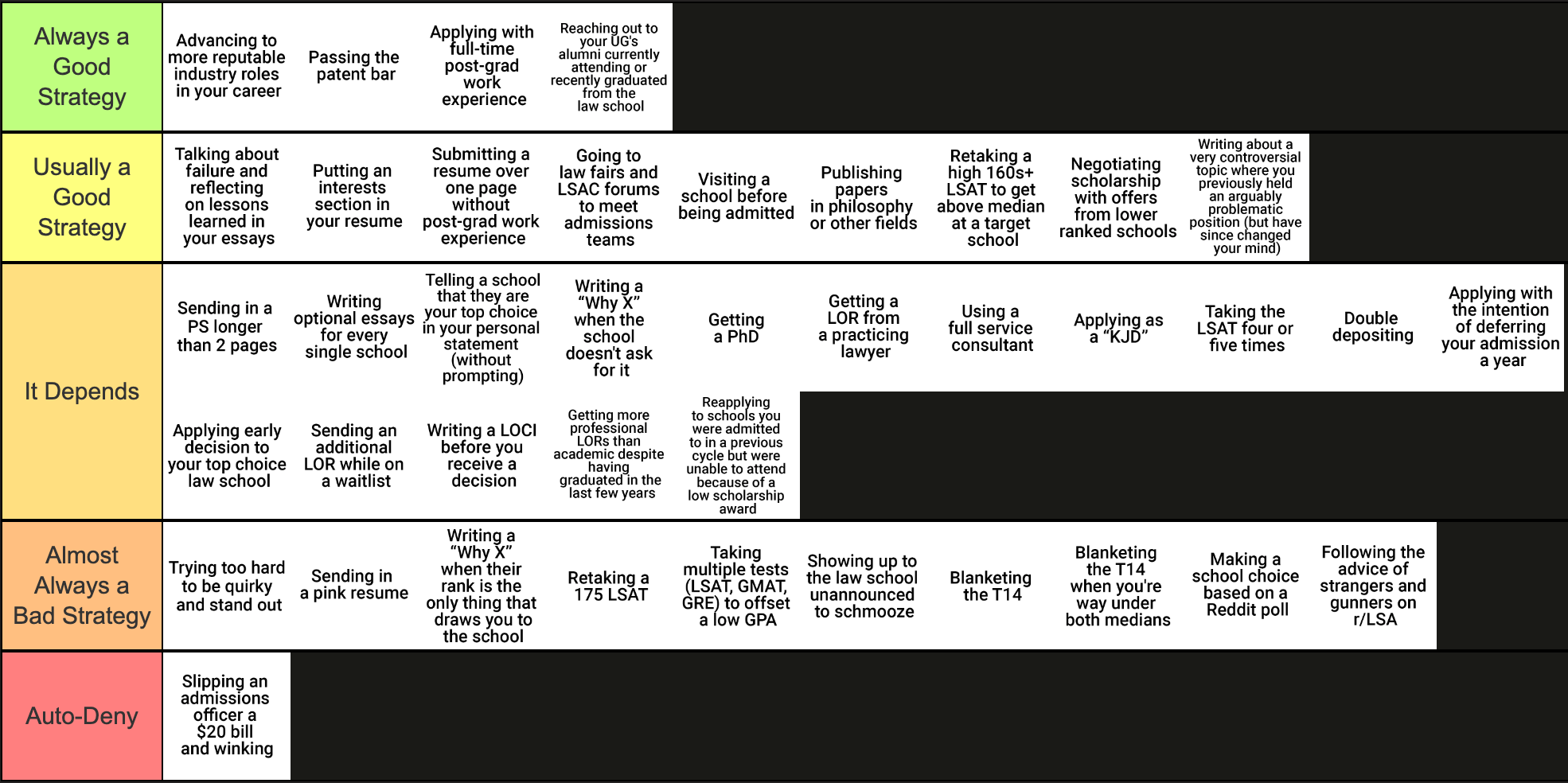
In this episode of Status Check with Spivey, Ann Perry, the University of Chicago Law School's Associate Dean for Admissions and Financial Aid, joins Mike Spivey and Anna Hicks-Jaco to tier-rank law school admissions strategies sourced from the folks over on the r/LawSchoolAdmissions subreddit. They talk about a huge range of topics, including personal statements, letters of recommendation, resumes, work experience, retaking the LSAT, attending law school forums, the value of using a consultant, and more.
You can listen and subscribe to Status Check with Spivey on Apple Podcasts, Spotify, and YouTube.
Here are the final tier ranks (please note that several of these were on the border and/or elicited mild disagreement—be sure to listen to the episode or read the transcript below for important notes and context):